
Running on Fumes in Foreign Lands: Why Taking Care of Yourself is the Best Way to Care for Your Kids

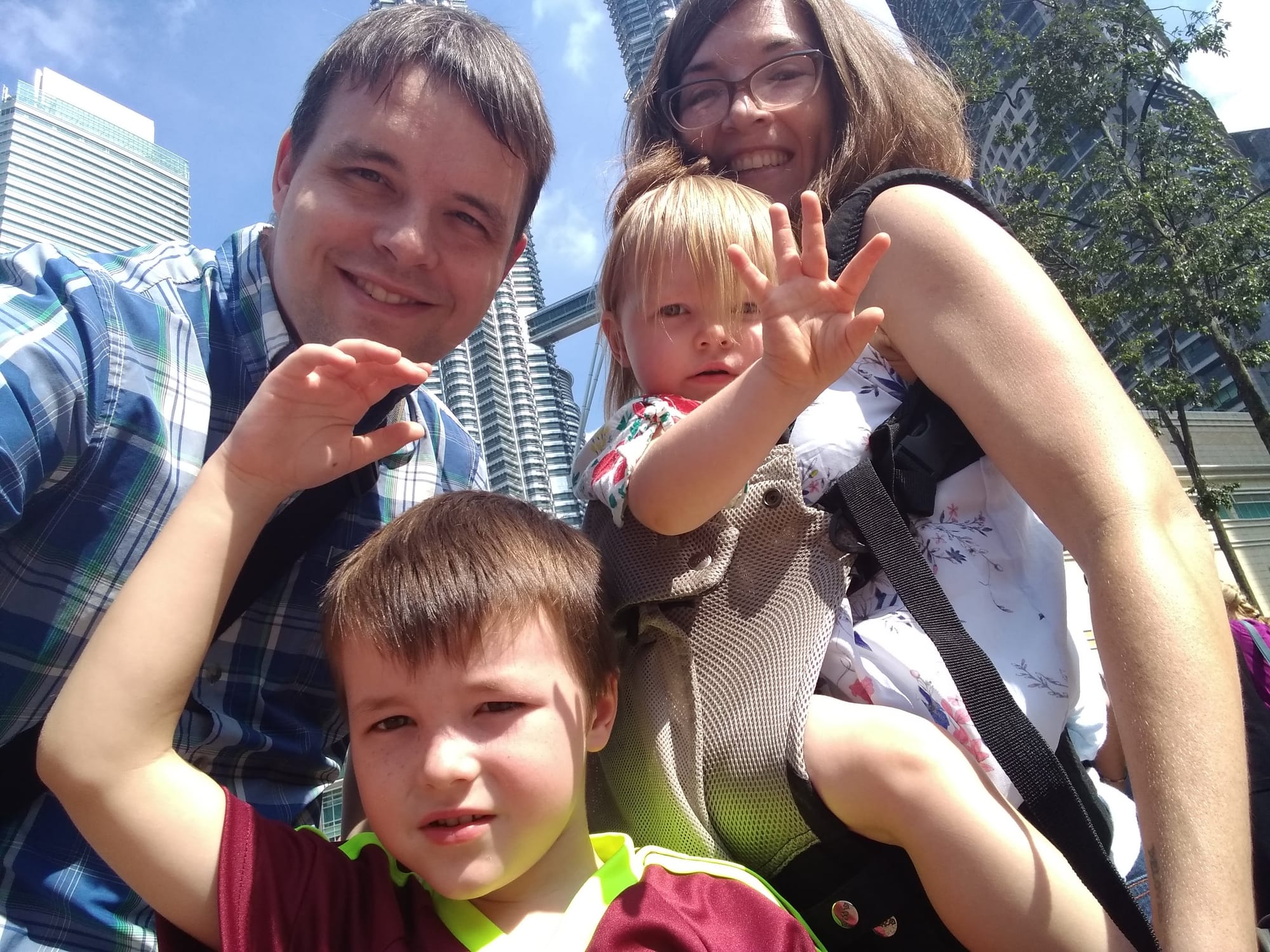
I think the depletion starts subtly, often long before we even pack our first international moving box. For me, the training ground for selflessness began in early motherhood.
First, it’s adjusting to the way food tastes and smells during pregnancy—when coffee suddenly smells like tuna. It’s getting ready for bed by gathering cookies, apples, and bananas to line up on your nightstand just to survive the morning nausea. It’s walking slower so you don’t accidentally trip as your weight begins to redistribute. Then, once the baby arrives, it’s sleeping only one to two hours at a time. It’s eating whatever you can hold with one hand that doesn't involve a fork and knife. It’s taking showers only when a fleeting window opens, and painstakingly rocking your child to sleep while you are dying to go to the bathroom—but you can't stop what you are doing because they are almost asleep.
This is rigorous training in putting your child's needs above your own. And it really needs to be this way, as your infant relies on you to survive. But, as I learned with my second child, sleep deprivation and chronic self-neglect are very real things. Dysregulated reactions to your children expressing their questions, frustrations, or feelings are a very real thing when you are just trying to survive.
As a global parent living in Venezuela between 2013 and 2018, just trying to get my kids into the car after grocery shopping could be anxiety-inducing. I would hurry my 4-year-old into his seat and frantically try to buckle up his 1-year-old sister, my eyes constantly scanning the perimeter, hyper-vigilant of people around us who might want to rob us. My reactions in these moments weren't about patiently helping my kids understand what was happening; they were about getting us to safety as quickly as possible.
Even if you aren't parenting in the midst of political upheaval and physical insecurity, the global mobility lifestyle demands a low-level, constant hum of anxiety. We are navigating finding furniture for our homes, figuring out appliances that work differently, and paying bills using systems we don't understand in languages we don't speak. We worry when we get emails from our kid's teacher about an incident at school. We exhaust ourselves trying to figure out the cultural misunderstandings that happen between us and our kids' friends' parents.
I was striving to be the perfect parent and to get it all right, but I was running on fumes.
After living through ten tumultuous, wonderful, and traumatizing years in Venezuela, we moved our whole family across the world to Malaysia in the span of just three weeks. There was no transition care for us. No one really checked in to see if we were okay. There was no debriefing as we left our beloved community, afraid for how things would go for them, while carrying the heavy guilt of leaving.
I was drowning in anxiety. During one of my first weeks in Malaysia, I ended up in the ER with one of my new coworkers. For nights, I had been going to sleep feeling like I was having a heart attack; the pain in my chest was so heavy. When they did the EKG, the doctors said I was fine. Probably stress, they said. It was the first time I had experienced a panic attack since I was a kid.
I felt stupid for going to the ER over a panic attack, but it started me on a vital journey. That was 2018, and finally, by 2020, I started going to therapy.
My body thought it was still living in Venezuela. I was afraid to walk outside my new, safe neighborhood. I looked around every corner expecting someone to jump out, or for a snake to be waiting at any step I wasn't paying close enough attention to. Anytime a motorcyclist drove by our car, I immediately locked the doors. My nervous system had been on high alert for years, and it didn't know how to turn off.
In working with my counselor, I began repeating a mantra to myself: "I'm as safe as I can be right now." That was as close as I could get to the truth, because I knew firsthand that sometimes "irrational" fears are actually entirely rational. Are you afraid there might be a rat in your toilet? Does that sound silly? Well, that actually happened to my neighbor's 8-year-old daughter. So, the work of simply recognizing the safety around me was where my healing had to start.
It also meant working with God to believe that He could be a safe place for me. I had come to believe that He was good and that He loved me, but I didn't believe He was safe, or that He could be trusted to protect me. My conversations during this time were heavily influenced by Mr. Rogers. I listened to the podcast Finding Fred (hosted by Carvell Wallace), wrestling with whether God really liked me the way I was, or if He just liked Jesus, whose sacrifice was covering my flaws. He told me He was my shepherd, and I had to figure out what that actually meant for my nervous system.
As parents, we can only give from what we have. If we have nothing, that's no good for anyone. For years, I believed self-care was selfish. I believed that taking time away from my family was wrong, and that waiting to go to the bathroom for hours because someone needed me was the definition of love.
But then, I saw the mirror my children were holding up to me.
One night, my son looked at me and said, "Feelings are bad. It's better not to have them."
That stopped me in my tracks. I really started to think about the way I had modeled this belief. How was my survival-mode coping affecting my kids?
Recent research from TCKTraining on Adverse Childhood Experiences (ACEs) in Third Culture Kids highlights how parental mental illness and emotional neglect deeply impact our children. We don't intend to emotionally neglect our kids, but when we are dysregulated, entirely burned out, and suppressing our own trauma, we cannot be the emotional safe harbors they need us to be.
I realized that God was showing me His care, and His bravery in facing His own feelings (Jesus Himself wept openly and did not hide His grief). I started listening to the wonderful Raising Boys and Girls podcast, and I began to learn a crucial truth: taking care of myself and processing my own feelings is a prerequisite to caring well for my kids.
If you are a parent living a transient, international life—or simply a parent running on fumes—please hear this: taking care of your mental and emotional health is not a luxury. It is a necessity.
To help you start, I’ve put together a short handout based on my own journey. When you feel the panic rising, or the sheer overwhelm of parenting cross-culturally taking over, try to walk through these four steps:
- Breathe: Deep breathing, like Square Breathing (in for 4, out for 4), helps calm your nervous system. Ground yourself using your 5 senses.
- Notice My Feelings: How is your body feeling right now? How do your thoughts feel? Use a feelings wheel to pinpoint exactly what emotion is sitting in your chest.
- Share My Feelings: Use "I feel..." statements. Acknowledging our feelings shows us they are manageable and points us toward needs we can actually care for.
- Talk to My Feelings: Ask yourself: If a friend said the things you say to yourself, would you want to be their friend? Tell yourself: "I can do hard things. I can try again. I am still learning. I am loved."
You are doing hard, brave work. Be kind to yourself today, so you can be there for them tomorrow.
Resources Mentioned: